The Echoes Series · Book 3
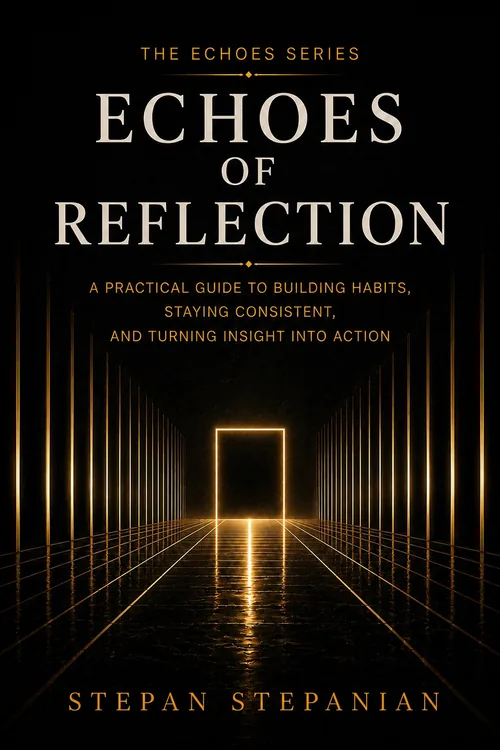
Echoes of Reflection
A Practical Guide To Building Habits, Staying Consistent, And Turning Insight Into Action
Echoes of Reflection shifts inward toward practical transformation, focusing on habits, consistency, structure, boundaries, and the quiet daily work required to translate insight into lived reality.
About the book
What happens after insight?
What happens when you already understand the pattern, recognize the problem, and genuinely want change — yet still struggle to turn awareness into consistent action?
Echoes of Reflection: A Practical Guide To Building Habits, Staying Consistent, And Turning Insight Into Action explores the quiet, practical work of transforming self-awareness into everyday behavior that can actually be sustained.
Rather than relying on motivation, intensity, or unrealistic routines, this book focuses on the small repeated actions that gradually reshape a life over time. Through calm, reflective, and deeply practical chapters, it examines how to begin when change feels overwhelming, how to protect attention in a distracted world, how to rebuild trust in your own follow-through, and how to create systems that survive ordinary life.
Written in a grounded and emotionally intelligent tone, Echoes of Reflection bridges the gap between personal insight and daily practice. It is designed for readers who are tired of temporary motivation and are looking instead for a steadier, more realistic approach to growth, consistency, discipline, and self-direction.
Inside this book, you’ll explore:
- How to start small enough to actually begin
- Why consistency matters more than intensity
- How to build habits that survive real life
- The importance of protecting attention and energy
- How to rebuild trust in your own follow-through
- Practical ways to repair mistakes without shame
- How to create boundaries that genuinely hold
- Why sustainable growth requires realistic pacing
- How to return after setbacks without starting over
- The difference between reflection and endless overthinking
This is not a book about perfection, productivity obsession, or dramatic transformation.
It is a book about building a steadier relationship with your own life — one practical action, one honest adjustment, and one repeated effort at a time.
Read a sample
Chapter 1 excerpt
Start Small Enough to Begin
A strong start should be clear enough to finish. This is where many attempts fail. The person chooses a beginning that still contains too many moving parts. They decide to organize their life, fix their health, rebuild their confidence, repair a relationship, or change their career, but those are not beginnings. They are territories. A beginning needs edges. It should answer what will be done, when it will stop, and what visible proof will remain afterward. Without those edges, even a sincere intention can dissolve into fatigue because the body cannot tell when the first effort has been completed.
The useful question is not whether the step is impressive. The useful question is whether it can be completed under the conditions that actually exist. If energy is low, the start must respect low energy. If time is limited, the start must fit inside the available window. If fear is loud, the start may need to be private, reversible, or deliberately unfinished. The first action should be small enough that resistance has less room to argue, but substantial enough to create contact with the real work. This balance is what makes a start humane and effective.
For a writing project, the start may be one rough paragraph placed under the correct heading, not a chapter polished into elegance. For a cluttered room, it may be one visible surface cleared and left clean, not the entire house reorganized. For money, it may be opening the account and writing down the exact balance, not building a complete financial plan. For a difficult conversation, it may be drafting the first honest sentence, not resolving years of tension in one exchange. Each start has a boundary that allows it to be completed instead of endlessly evaluated.
Completion matters because the nervous system learns from closure. A half-start that never lands can increase frustration. It confirms the old feeling that nothing is really changing. A completed small start, however, creates a different record. It gives the person proof that movement is possible without waiting for ideal conditions. This proof may be quiet, but it begins to alter the emotional atmosphere around the next attempt. The work becomes less distant because it has already been entered once.
Read or listen
Buy the audiobook on Spotify or use the monthly audiobook listening time included with an eligible Spotify Premium plan.