The Echoes Series · Book 4
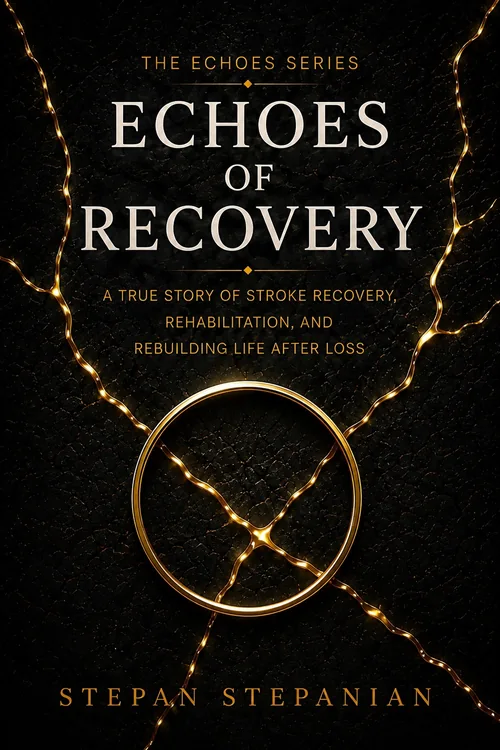
Echoes of Recovery
A True Story of Stroke Recovery, Rehabilitation, And Rebuilding Life After Loss
Echoes of Recovery brings those themes into direct lived experience through a personal story of stroke recovery, rehabilitation, loss, adaptation, and rebuilding life after profound interruption.
About the book
Recovery is not a single moment of survival.
It is the long, quiet process of learning how to continue after life has been interrupted.
Echoes of Recovery: A True Story of Stroke Recovery, Rehabilitation, And Rebuilding Life After Loss is a deeply reflective memoir about surviving a catastrophic stroke and navigating the difficult, often invisible reality of recovery afterward.
Written with honesty, emotional precision, and restraint, this book traces the experience from the ordinary days before the stroke, through hospitalization and rehabilitation, into the slow rebuilding of identity, movement, independence, and meaning. Rather than presenting recovery as inspirational simplification or motivational performance, it explores the reality of physical limitation, dependence, confusion, frustration, adaptation, and the demanding emotional work of continuing through profound change.
Through intimate observations and deeply human reflection, Echoes of Recovery examines what happens when the body no longer responds the way it once did, when ordinary tasks become unfamiliar challenges, and when life must be reconstructed from within uncertainty rather than certainty.
This is not a story about returning to the past.
It is a story about learning how to live inside what changed.
Inside this memoir, readers will explore:
- The sudden rupture caused by catastrophic medical trauma
- The psychological and emotional reality of stroke recovery
- Physical rehabilitation and the slow rebuilding of movement
- The hidden emotional weight of dependence and limitation
- The relationship between identity, memory, and the body
- How ordinary routines become meaningful after loss
- The quiet role of friendship, family, and human connection in recovery
- The internal reality of rehabilitation rarely visible from the outside
- The psychological impact of uncertainty, interruption, and adaptation
- The gradual rebuilding of life after physical and emotional collapse
Written in a calm, introspective, and deeply human voice, Echoes of Recovery offers a raw and honest account of survival without exaggeration or false inspiration. It is a book for readers interested in memoirs of illness and recovery, emotional resilience, rehabilitation, personal transformation, and the fragile structures that quietly sustain ordinary life.
Read a sample
Chapter 7 excerpt
The Quiet Strength of Expansion Within Limits
Another defining moment came when I went outside in the wheelchair for the first time. Until then, my world had been contained within structured indoor environments: rooms, hallways, therapy spaces, and the repeated routes between them. Everything had been organized around treatment, assistance, and predictable movement. Going outside did not change my condition, but it changed the atmosphere around it. The realization that the world was still there was immediate. The meaning of that realization settled more gradually.
At first, what mattered most was simply that life existed beyond the walls that had framed my recovery. The sunlight, the air, and the space around me all felt familiar and distant at the same time. The most distinct detail that stayed with me was the feel of the hot sun on my skin again. It did not feel emotionally restorative in a simple way. It felt more like a reminder of how long I had been separated from ordinary life. Being outside made me feel connected to life, but it also made me aware that I was still in the wheelchair. Both truths were present at once, and neither canceled the other.
That was the nature of expansion during this period. It did not mean the limits were disappearing. It meant the limits were beginning to contain more life than they had before. The wheelchair still defined my mobility. Assistance still shaped my movement. Therapy still organized much of the day. Yet inside those facts, the world had begun to widen. I could sit longer. I could tolerate more. I could go outside. I could hold conversation with more ease. I could imagine the next stage without feeling completely overtaken by it. None of that made me independent, but it made me less enclosed.
Read or listen
Buy the audiobook on Spotify or use the monthly audiobook listening time included with an eligible Spotify Premium plan.