The Echoes Series · Book 1
Echoes of Illusion
How Perception Shapes Reality, Thought Patterns, And Emotional Experience
Echoes of Illusion examines how perception shapes emotional experience and the stories people mistake for truth.
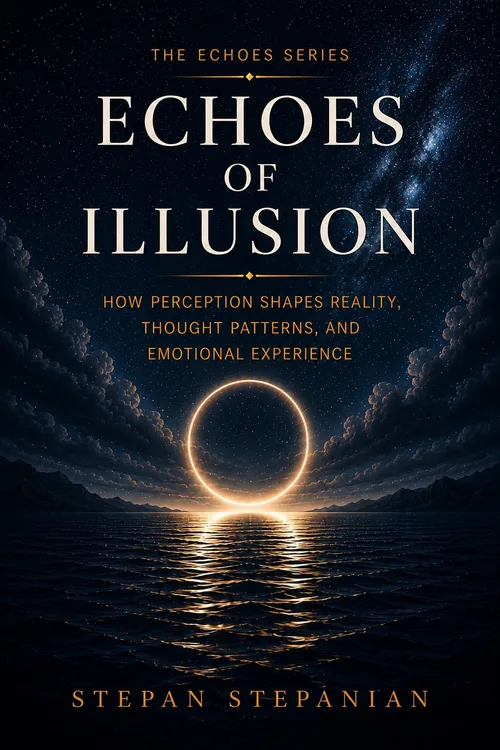
About the book
Echoes of Illusion explores the hidden assumptions, perceptions, and emotional distortions that quietly shape everyday life. Through reflective insight and grounded human observation, the book examines the illusions surrounding time, control, certainty, relationships, success, failure, happiness, identity, and fulfillment.
Rather than offering dramatic answers or rigid philosophies, the book invites readers to question the stories they unconsciously accept as truth and to examine how those stories influence emotion, behavior, and perspective.
Echoes of Illusion encourages a deeper awareness of the ways perception shapes reality and how greater clarity can create a more truthful and grounded way of living.
Read a sample
Chapter 3 excerpt
The Illusion of Certainty
A person who cannot tolerate uncertainty may confuse intensity with clarity. They may take a strong feeling as proof that something is true simply because the feeling is loud. Anxiety says leave now, so they leave. Desire says this is perfect, so they ignore what is inconsistent. Fear says you will fail, so they do not begin. The emotional volume creates the appearance of knowledge. But feelings, while important, are not always accurate narrators. They reveal what is activated inside us, not necessarily what is true outside us. When emotion becomes the only evidence, certainty becomes a mood wearing the clothing of fact.
This is where the simple distinction between facts, stories, and values becomes useful. Facts describe what can be observed. Stories describe the meaning the mind attaches to those facts. Values describe how a person wants to move regardless of the uncertainty that remains. If the fact is that no one has replied to a message, the story may be that everyone is upset, uninterested, or disappointed. The value may be steadiness. From steadiness, the next step might be to wait, follow up politely, or turn attention toward work that can actually be done. The value does not erase uncertainty, but it prevents uncertainty from taking control of behavior.
In difficult seasons, values become more reliable than predictions. Predictions depend on knowing what will happen, and often we do not. Values depend on knowing who we want to be while it happens. This shift is small, but it changes the emotional center of decision-making. Instead of asking, what outcome can I guarantee?, a person begins asking, what action would be honest, responsible, and aligned with what I know right now? The future is still open, but the present becomes less chaotic. Direction replaces guarantee.
Read or listen
Buy the audiobook on Spotify or use the monthly audiobook listening time included with an eligible Spotify Premium plan.