The Echoes Series · Book 2
Echoes in the Maze
Understanding Inner Conflict, Emotional Patterns, And Why Change Feels So Difficult
Echoes in the Maze moves into the complexity of human behavior, emotional patterns, resistance, and the difficult space between awareness and action.
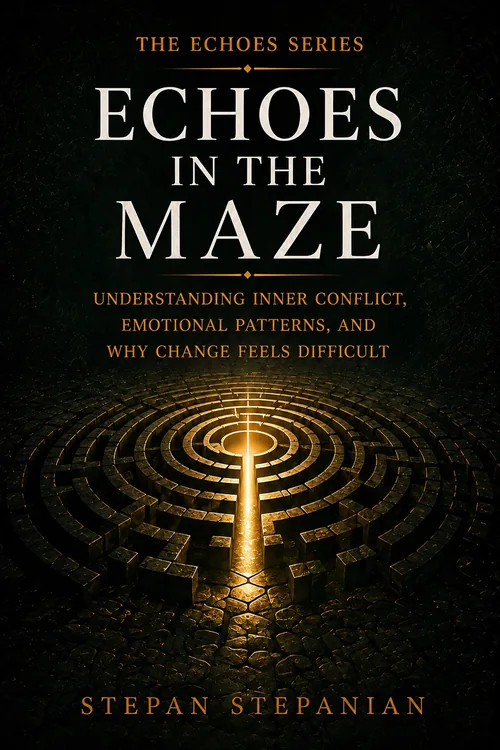
About the book
Why do we continue repeating patterns we already understand?
Why does awareness so often fail to become change?
Echoes in the Maze: Understanding Inner Conflict, Emotional Patterns, and Why Change Feels So Difficult explores the difficult space between knowing and doing — the internal struggle that keeps people trapped in familiar cycles even after they have clearly recognized them.
Through deeply reflective and psychologically grounded chapters, this book examines the hidden emotional patterns that shape behavior over time: resistance, hesitation, self-criticism, comparison, avoidance, emotional contradiction, overthinking, and the quiet ways people protect what is familiar even when it no longer serves them.
Rather than offering shallow motivation or unrealistic solutions, Echoes in the Maze approaches personal growth with honesty, clarity, and emotional precision. It explores why change can feel so difficult even when a person genuinely wants it, and why awareness alone is often not enough to create lasting transformation.
Written in a calm, introspective, and deeply human tone, this book is designed for readers seeking meaningful self-reflection, emotional insight, and a clearer understanding of the internal conflicts that influence everyday life.
Inside this book, you’ll explore:
- The distance between awareness and action
- Why resistance often survives understanding
- The emotional weight of self-expectation
- The quiet damage caused by comparison
- How familiar patterns shape identity and behavior
- The difference between self-awareness and self-punishment
- Why lasting change requires more than motivation
- How honesty and clarity gradually reshape the inner life
This is not a book about perfection, quick fixes, or becoming someone entirely new.
It is a book about learning to understand yourself honestly enough to stop living unconsciously inside the same patterns — and beginning, slowly and steadily, to move forward differently.
Read a sample
Chapter 6 excerpt
The Weight of Self-Expectation
Self-expectation begins to change when the imagined future self stops being used as a weapon against the present one. That future self may still matter. It may still offer direction, possibility, and hope. But it cannot become a figure who stands at a distance, condemning the person for not arriving faster. If growth is to become sustainable, the present self must not be treated as an obstacle to be defeated. It must be treated as the only actual place from which movement can begin.
This is a difficult adjustment because the present self is often where the evidence feels most complicated. It contains the habits that remain, the fears that still rise, the inconsistencies that continue to frustrate, and the tender places that have not yet healed. It is easier to admire the future self because that version has not yet had to live an ordinary Tuesday under pressure. It has not had to answer the message, face the fatigue, sit with uncertainty, repair the mistake, or choose again after disappointment. The imagined future self appears cleaner largely because it has not yet been tested by ordinary reality. The present self is messy because it is real.
A person begins to reclaim steadiness when they stop demanding that the real self perform like the imagined one before it has grown into that capacity. This does not mean accepting stagnation. It means allowing growth to occur through an honest relationship with the self that actually exists. The person can still want more. They can still expect integrity, effort, and movement. But the expectation must be rooted in reality, not in contempt for the pace at which reality changes.
Read or listen
Buy the audiobook on Spotify or use the monthly audiobook listening time included with an eligible Spotify Premium plan.